
Clinton County Probation Versus Parole
Probation is a sentence or court-supervision status ordered in a Clinton County case. It is supervised locally. Parole and mandatory supervised release, often called MSR, follow Illinois state imprisonment and are supervised through the IDOC Parole Division. The Illinois Prisoner Review Board, or PRB, sets conditions and decides designated parole, MSR, revocation, and discharge matters. It is separate from both the county office and IDOC field supervision.
A person can leave Clinton County Jail on probation without ever entering IDOC. Another person may transfer from the jail to IDOC, later leave a state prison on MSR, and remain under state supervision. Physical release from a building is not the same as the end of supervision. The status, supervising authority, and discharge record must agree.
| Feature | County probation | State parole or MSR |
|---|---|---|
| Source | Clinton County court order | Illinois prison sentence and state release law |
| Field supervision | Clinton County Probation | IDOC Parole Division |
| Public verification | Court docket and Circuit Clerk | IDOC offender search and archived Record Search |
| Decision body | County court | PRB for specified decisions and conditions |
| End point | Court-recorded completion or discharge | State final discharge, not merely prison release |
Verify Clinton County Post-Release Supervision
Begin with the court case because it identifies the sentence. Clinton County links a county-specific Judici endpoint, while the Circuit Clerk keeps the official documents. A probation order and its term point to the local office. A mittimus, which is a commitment order, points to IDOC. If the person appears in the state search with parole or MSR status, state supervision continues even though prison custody ended.
- Search the Clinton County court case and match the name, case number, and disposition.
- Read whether the sentence imposed probation or commitment to IDOC.
- For local probation, obtain verified documents from the Circuit Clerk and use County Probation for procedure.
- For state supervision, search IDOC by IDOC number, name, or date of birth and read current status.
- For a PRB matter, compare the hearing calendar, decision or minutes, and current IDOC status.
- Confirm completion through the court or state discharge record rather than assuming that time has expired.
The IDOC Individual in Custody Search can display parole status, admission and release information, sentence data, and a projected parole date. The pictured official IDOC search illustrates that state route.
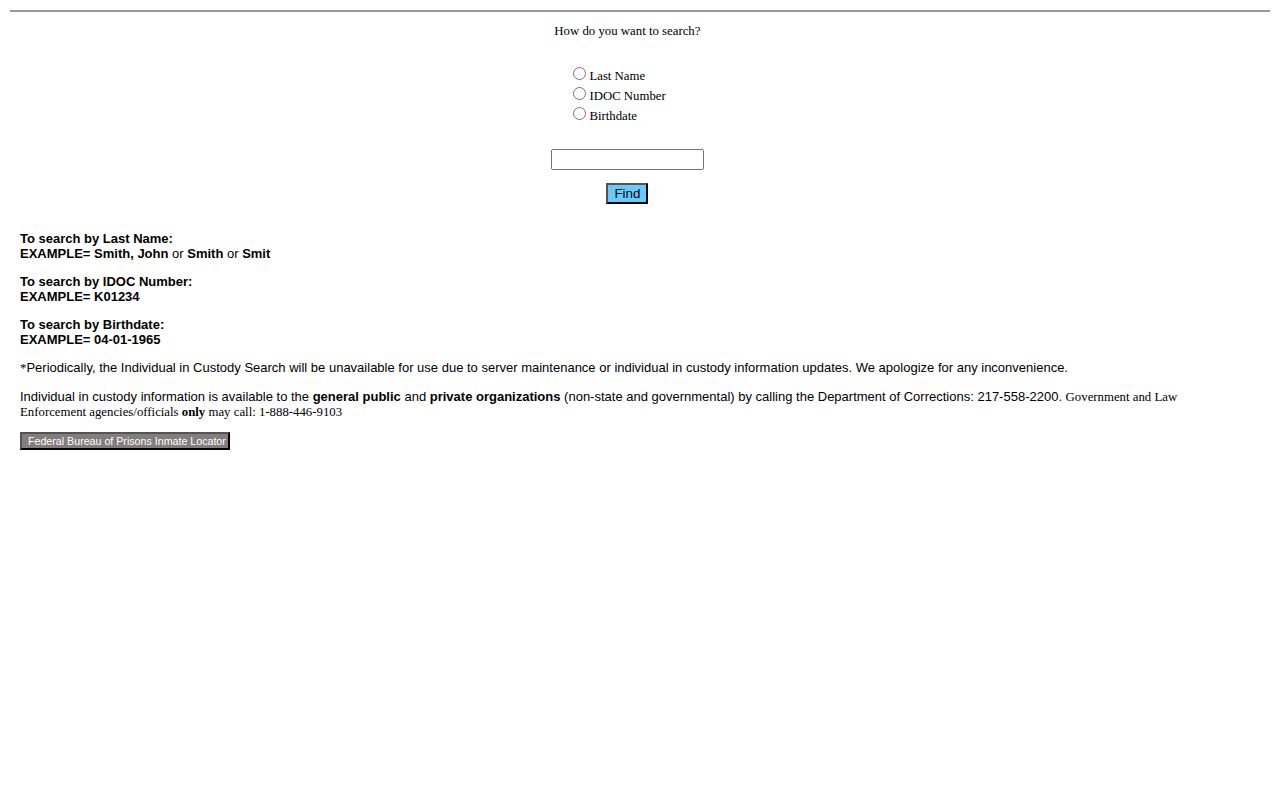
The status field must be read with the dates because a projected date alone does not prove physical release or final discharge.
Clinton County Probation Office Details
The Clinton County Probation office publishes unusually useful routing details. It is in Room 120 of the Clinton County Courthouse at 850 Fairfax Street in Carlyle. Office hours are Monday through Friday, 7:30 a.m. to 4:00 p.m. The general line is 618-594-6635, fax is 618-594-0199, and email is probation@clintonco.illinois.gov.
Clinton County Probation850 Fairfax Street, Room 120
Carlyle, IL 62231
618-594-6635
probation@clintonco.illinois.gov
Monday–Friday, 7:30 a.m.–4:00 p.m.
The office supervises county court probation and supervision, not IDOC parole. It publishes no public client lookup. Contact it for office procedure, program information, and reporting-location questions, not with an expectation that confidential facts about a named person will be disclosed. The Circuit Clerk is the official court-document source.
The official county Probation page is shown below.
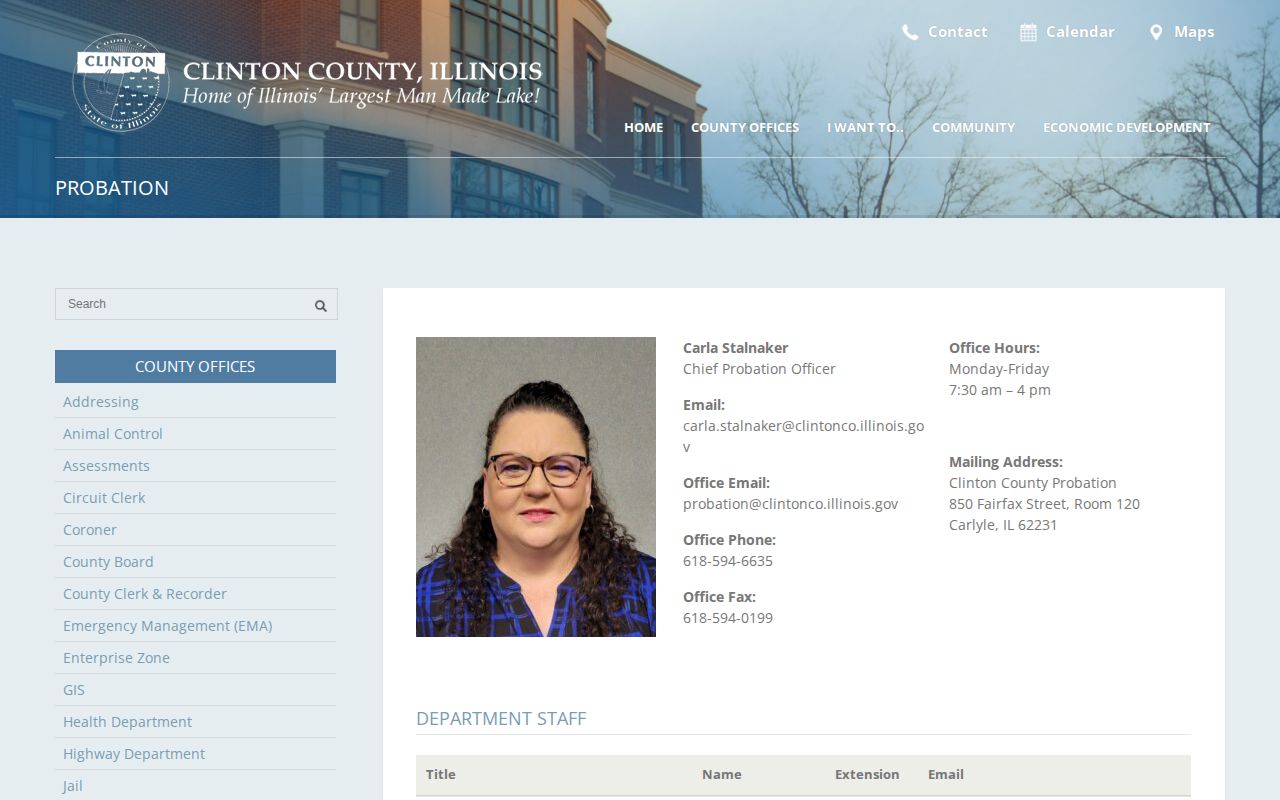
Its staff and service information helps route a local probation question without confusing the county office with state parole.
Clinton County Reentry Service Links
County Probation publishes local programs and service channels, including Community Resource Center. The 2024 jail inspection also identifies Community Resource Center as a provider of added mental-health services inside Clinton County Jail. Together, the sources show a documented point of continuity between custody and the community.
This is a navigation fact, not evidence about a named person. A release record does not prove participation in Community Resource Center, Drug Court, Thinking for a Change, Moral Reconation Therapy, or any other service. Use the county office’s published service list to identify a possible contact, then rely on the person’s own court and supervision documents for actual requirements.
Clinton County’s local route remains distinct from state parole programming. A person released from IDOC should follow the state reporting instructions and parole contacts attached to that release. A person sentenced to county probation follows the local court order and County Probation instructions.
Clinton County Discharge Property Records
The 2024 jail inspection checks that Clinton County Jail permanently retains an itemized, signed personal-property receipt. This locally specific record can survive after current-custody information is gone. It may corroborate the jail’s discharge process, but it does not prove that supervision ended. A person can sign for property while leaving jail and still begin probation, parole, or MSR.
The inspection also addresses medication documentation and community-resource linkage for mentally ill detainees. Health information is restricted. The point is procedural: discharge can create several records, and each has a different scope. Ask for the jail custody event and property receipt where appropriate, then use the court order or IDOC status for the supervision question.
A complete release search is available on the Clinton County released inmates home page. It separates the Sheriff’s physical exit record from court authority and state supervision.
Clinton County Parole Hearing Records
The Illinois Prisoner Review Board is the decision and condition body for specified state matters. Its hearing hub separates en banc, revocation, MSR, and other proceedings. PRB convenes monthly en banc sessions for legacy indeterminate and youthful-parole cases. The yearly schedule gives meeting dates, while facility calendars identify docket types.
After a hearing, compare Current En Banc Results, the open minutes archive, the past-paroles registry, revocation results, and IDOC status. A grant is approval subject to release planning and conditions. It does not prove that physical release happened on the vote date. A denial means no grant at that decision. A deferral means the issue will receive later consideration. Rescission or revocation affects a previously available status and must be read from the specific result.
The official PRB annual calendar supplies the monthly schedule.
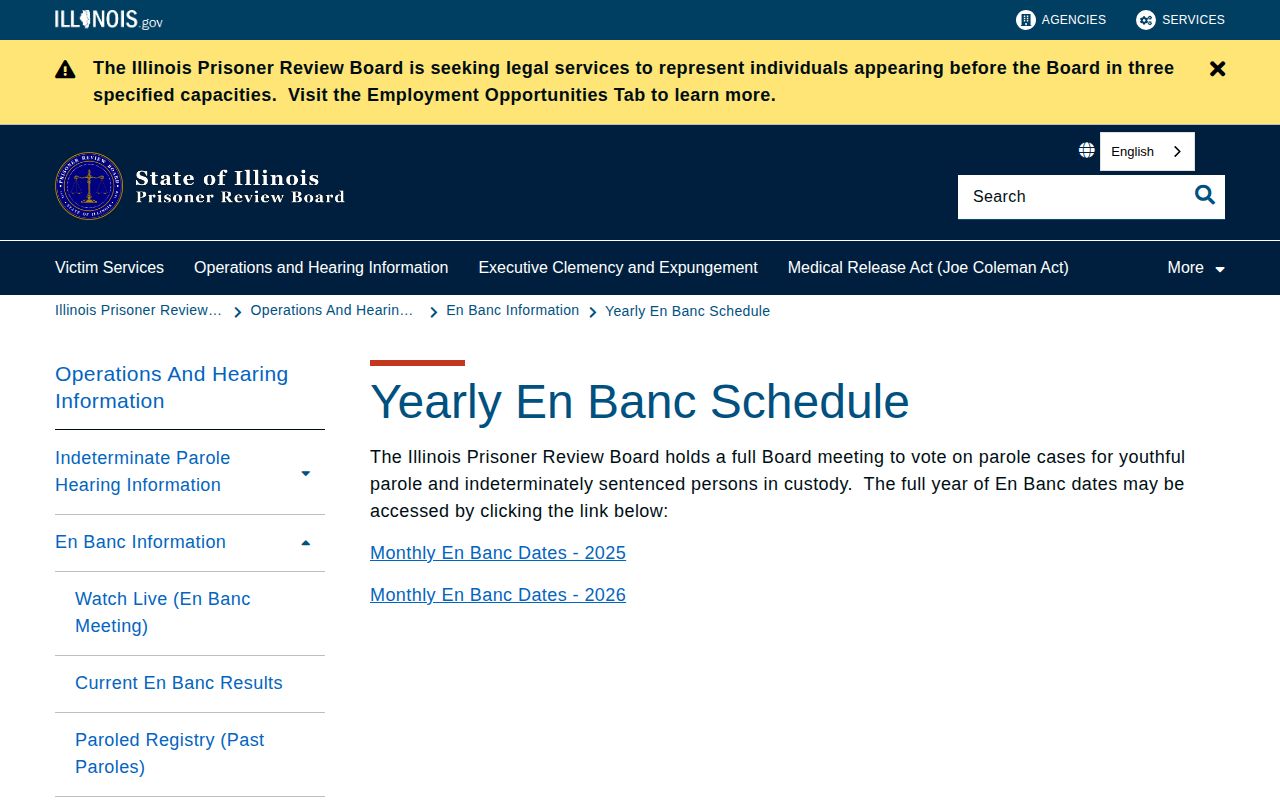
The calendar establishes a scheduled proceeding, not release; the decision and IDOC status supply the next evidence.
Legacy parole eligibility under 730 ILCS 5/3-3-3 and youthful review under 730 ILCS 5/5-4.5-115 depend on the sentence, offense, timing, and exclusions. Modern determinate sentences usually lead to MSR rather than traditional discretionary parole. No calendar date guarantees release.
Clinton County Warrants and Absconders
Conditions of probation, parole, or MSR come from the controlling court order, release document, and supervising authority. A violation allegation, arrest, or detention does not by itself establish revocation. PRB revocation results concern state supervision enforcement and must be read from the particular proceeding. County probation violations belong in the Clinton County court record.
Public wanted channels are limited. IDOC maintains a Wanted Fugitives page. Its parolee sex-registrant search is narrower and covers only people under IDOC parole or MSR who are required to register as sex offenders. No Clinton County public probation-absconder list was found. An entry on a wanted or warrant channel indicates an enforcement issue, not completed discharge.
Illinois State Police registries apply only to qualifying statutory categories. They are not general parole or release lists. VINELink may report custody and court-event changes based on contributing feeds, but it is an alert system rather than a complete supervision archive. Confirm any alert with the court, jail, IDOC, or PRB that supplied the event.
- Absconder
- A supervisee alleged to have stopped reporting or left supervision without authority.
- Revocation
- A formal decision withdrawing a release or supervision status after the required process.
- Parole
- Conditional community release under state supervision in cases governed by parole law.
- Probation
- A county court sentence or supervision status served under local court authority.
- MSR
- Mandatory supervised release following an Illinois prison term.
End Clinton County Supervision Status
Supervision ends through the authority that imposed or administers it. For local probation, review the Clinton County case for completion, discharge, modification, or violation proceedings and obtain verified documents from the Circuit Clerk. For state parole or MSR, use IDOC status and the relevant PRB record. IDOC’s live public search is limited to people currently incarcerated or on parole, so a fully completed sentence may require the archived Record Search route.
PRB early final discharge is distinct from release from prison. Someone may live in the community on parole or MSR yet remain under supervision. Conversely, a scheduled hearing does not show that prison custody ended. The strongest conclusion joins the actual release event, current supervision status, and final-discharge record from the responsible authority.
Note: A no-result from a live search is inconclusive; name matching, source coverage, timing, and completed-sentence archive limits must be checked first.