
IDOC Releases From Clinton County Cases
A transfer from Clinton County Jail to IDOC is continued custody, not release into the community. The county court mittimus, which is the commitment order, and the jail transfer event establish why local custody ended. IDOC then becomes the responsible custodian. State release may later be to parole or mandatory supervised release, often shortened to MSR, final discharge, another custodian, or another placement.
Parole and MSR mean the person has left the prison building but remains under state supervision. Final discharge means the IDOC sentence and supervision status identified by the agency have ended. These are not interchangeable. A projected parole date is only a forecast, while an actual release date paired with current status carries more weight. Another hold or receiving jurisdiction can still affect where the person went.
| IDOC result | Custody meaning | What to verify |
|---|---|---|
| Named institution | State imprisonment continues | Current location and sentence fields |
| Parole or MSR | Out of prison under supervision | Actual release data and supervision status |
| Projected Parole Date | Forecast, not a guarantee | Later profile changes and actual event |
| No live result | Inconclusive | Record Search archive, county-only or federal path |
Search IDOC Clinton County Records
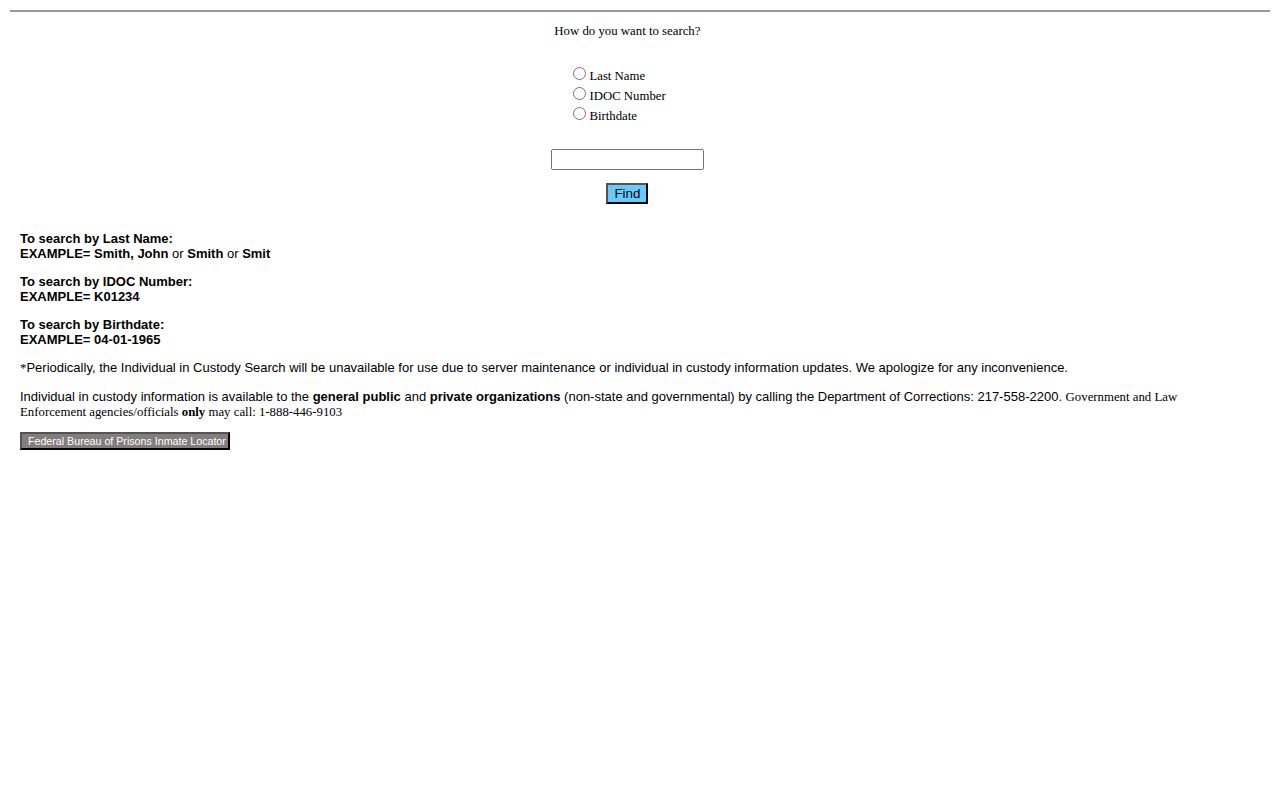
The IDOC Individual in Custody Search accepts an IDOC number, a last name including partial spelling, or date of birth. Use the IDOC number first when known because names can collide. Otherwise try the full and partial last name, then match the date of birth and vital statistics. Do not assume a name match is the same person.
- Search by IDOC number, or use name and date of birth.
- Match identity through the profile’s stable details.
- Read current institution or status before reading any date.
- Compare admission, release, sentence, and Projected Parole Date fields.
- Return later for changes and use Record Search when a completed sentence disappears.
A live profile may show name, IDOC number, parent institution, current location or status, vital statistics, admission and release dates, sentencing information, a photograph, and the Projected Parole Date. Record both the displayed date and the date of access. IDOC explains that earned-credit changes that revise the projection are reflected on the profile, but eligibility for a discretionary credit does not promise an award.
The official IDOC search result interface illustrates the fields used to separate imprisonment from release to supervision.
Status and actual event fields should be read together rather than treating the first date on a profile as final discharge.
IDOC Live Search Archive Limit
IDOC’s most important limitation is easy to miss. Its public live search shows publicly disclosable information for people currently incarcerated or on parole. Once a sentence is completed, that person’s information is not displayed. A missing result can therefore mean final discharge, a county-only sentence, a spelling mismatch, timing, or custody in a different system. It cannot safely be translated into “released” without another record.
For a completed sentence, use IDOC’s Contact Us workflow and select Record Search as the General Subject. Supply the full name, date of birth, approximate reception year, known institutions, county of conviction, and relevant dates. Ask for admission, release to supervision, and final-discharge information. IDOC’s public individual-information phone is 217-558-2200.
This route differs from the Clinton County jail request. The Sheriff holds the local booking and transfer event. IDOC holds the later state admission, institution, release-to-supervision, and final-discharge history.
Clinton County Commitment Proof
Before using IDOC, confirm that the Clinton County case actually produced a state commitment. The Clinton County Circuit Court record may show sentence, jail credit, and mittimus. The Clinton County Jail event should then show transfer to IDOC rather than community release. Together, those two records prevent a person who served only a local jail sentence from being forced into the wrong search system.
IDOC does not cover an other-county boarder merely housed in Carlyle, a federal detainee boarded for USMS, or a person who served only at Clinton County Jail. For a local jail event, contact the jail. For a federal sentence, search BOP. The statewide IDOC page applies only after Illinois state custody becomes the controlling path.
- Mittimus
- The court document committing a sentenced person to a correctional authority.
- MSR
- Mandatory supervised release, a period in the community under state supervision.
- Parole
- Conditional release from prison under supervision in cases governed by parole rules.
- Final discharge
- The end of the state corrections sentence and supervision status recorded by IDOC.
A full named-person custody workflow is available through the Clinton County released inmates search.
IDOC Release Dates Can Change
The profile label is Projected Parole Date, not guaranteed release date. Sentence calculation can change with judicial orders, sentence-credit awards or loss, disciplinary action, detainers, and other legal inputs. Illinois sentence credit is primarily governed by 730 ILCS 5/3-6-3. The particular offense, sentence date, and statutory rules determine which credits and release structure apply.
IDOC states that an Earned Sentence Credit adjustment changing the projected date is communicated to the person and reflected in the profile. It also says eligibility is not entitlement and does not allow a promise that a named person will receive a discretionary award. A careful record notes the projection, retrieves the profile again, and distinguishes it from the later actual release event.
Traditional parole, modern MSR, and youthful review also follow different legal paths. The Illinois Prisoner Review Board may set conditions and decide specified matters, but a hearing calendar or favorable vote alone does not prove physical release. Pair any board result with IDOC’s current status and actual date.
Illinois State Release Destinations
A state release can lead to community supervision, final discharge, or another custodian. BOP notes the same broad problem in the federal setting: an agency’s custody can end while another authority continues to hold the person. For an Illinois profile, use the current status, actual release data, and court or receiving-agency records to determine which outcome occurred.
No IDOC prison was found physically in Clinton County. Statewide institutions and transition centers serve people committed from Clinton County; they are not a local facility at the Carlyle address. Facility-specific questions belong with the institution shown on the profile. Archived state-release questions belong with IDOC Record Search.
Illinois Department of CorrectionsStatewide custody and records system
Public information: 217-558-2200
Individual in Custody Search landing page
Note: County probation is not IDOC parole; locally ordered probation is verified through the Clinton County court and Probation office.