
Understanding Clinton County Releases
“Released” is an exit from one custodian, not always the end of custody. The Clinton County Jail may release someone under a court order, after time served, or at the end of a county sentence. It may also deliver a sentenced person to the Illinois Department of Corrections, return an out-of-county detainee to the originating county, or return a federal boarder to the U.S. Marshals Service. Those transfers remove the person from the Carlyle jail without placing the person in the community.
The best Clinton County release record therefore identifies the time, exit category, authority, and destination. A live roster, if one existed, would answer who is presently held. Clinton County does not publish an official online roster or recent-release archive. Once a name is absent, use the Sheriff's custody event, the Circuit Clerk record, and the system that received the person. This chain separates a true community release from a move between agencies.
- Discharge
- The end of a custody or supervision term recorded by the responsible agency.
- Time served
- Release after the ordered custodial term and credited time have been satisfied.
- Parole or MSR
- Community release from state custody while IDOC supervision continues.
- Detainer
- A request or legal basis for another authority to take custody.
Clinton County Release Paths
The label on the exit event controls where to check next. Court-ordered pretrial release and dismissal should be paired with the docket because the order supplies legal authority while the jail supplies the actual exit time. A completed county sentence stays in local jail and court records. State commitments move into IDOC records. Federal boarders require the federal docket, USMS custody history, and sometimes the Bureau of Prisons Locator.
| Exit type | What it means | Next source |
|---|---|---|
| Court-ordered release | The jail carries out a judge's release order if no other hold prevents it. | Sheriff custody event and Circuit Clerk docket |
| Time served | The county custodial term has ended. | Jail release record and sentencing entry |
| Probation | The court orders local community supervision, which is not state parole. | County court record and Clinton County Probation |
| IDOC commitment | The person leaves the county jail for state custody. | IDOC Individual in Custody Search |
| USMS or other county transfer | The boarding arrangement ends, but custody continues elsewhere. | Receiving agency and court record |
| ICE transfer | Immigration custody may follow the local exit. | Jail destination field and ICE records |
A release order alone does not prove the person walked out. Another warrant or hold may intervene. Likewise, a jail exit alone does not prove community release. The destination field resolves that gap.
Fields in Clinton County Release Records
No public Clinton County web form displays a fixed release-field set. A focused request should ask the Sheriff for the existing booking and custody-event fields needed to identify the person and interpret the exit. Avoid asking the office to decide whether someone is “free.” Request the record elements instead.
| Field | What it establishes |
|---|---|
| Legal name and date of birth | Matches the event to the correct person. |
| Booking number | Links the release to a specific jail admission. |
| Admission date and time | Marks the start of that custody episode. |
| Exit date and time | Shows when Clinton County physical custody ended. |
| Release or transfer type | Distinguishes community release from a custody move. |
| Release authority | Connects the event to a court order, sentence, or agency action. |
| Receiving agency or destination | Identifies IDOC, USMS, another county, or another placement. |
| Property receipt | Documents itemized property handling during discharge. |
The 2024 IDOC jail inspection confirms that Clinton County permanently retains an itemized property receipt signed by the detainee. That locally distinctive discharge record may survive after current-custody information disappears. Medical and mental-health material is more restricted, even though the inspection also reviews medication documentation and discharge linkage.
Request Clinton County Release Records
Send a written Illinois Freedom of Information Act request to Sandra Basler, Clinton County FOIA Officer, and state that the responsive jail material is held by the Sheriff or Clinton County Jail. The official Clinton County FOIA page lists the route. A request may use the county form, but Illinois law generally does not require that form or a statement of purpose.
- Gather the full legal name, date of birth if known, booking number, case number, and a narrow date range.
- Ask for the existing custody-event record, admission and exit timestamps, exit type, release authority, destination, and booking photograph if maintained and disclosable.
- Ask separately for the signed discharge property receipt when it helps confirm the event.
- Request electronic copies in their existing format and keep the written response, exemption citation, and any extension notice.
- If an old record no longer exists, request the Local Records retention schedule and disposal authorization.
850 Fairfax Street
Carlyle, IL 62231
618-594-6645
foia@clintoncosa.illinois.gov
For an ordinary noncommercial request, 5 ILCS 140/3 generally requires a response or written denial within five business days. A listed reason can support one extension of up to five more business days. The first 50 black-and-white letter or legal pages are free; later pages may cost no more than 15 cents each. Email delivery usually avoids a physical-medium charge.
Illinois Rules for Clinton Releases
Illinois FOIA presumes access to nonexempt public records, while Section 7 protects specified private, investigative, safety, juvenile, and correctional information. An agency should separate protected material and release the remainder when practical. FOIA governs access, not retention. Local record schedules control lawful disposal.
Sealing and expungement are different. Sealing limits ordinary public access to an eligible record. Expungement applies statutory destruction or return rules to eligible arrest and court records. Eligibility depends on disposition, offense, and time under 20 ILCS 2630/5.2. The Illinois Courts forms provide the approved process. A missing web result is never proof that no booking occurred.
Find a Released Clinton County Inmate
Begin with the last known custodian. Clinton County has no official online roster, 24-hour list, or 72-hour list. That makes a phone check and a written custody-event request the local starting point. The wider Clinton County 24-hour release process explains how to ask for a precise same-day interval.
- Call the Clinton County Jail at 618-594-4556. Ask whether the person is currently held and, if not, request the last event, time, category, and destination.
- Search the Clinton County court case. Match the release or detention order, disposition, sentence, probation, or commitment to the jail event.
- If the person entered state custody, search IDOC by last name, IDOC number, or birth date. Read status, admission details, institution, and Projected Parole Date together.
- Use Illinois VINE for a source-reported release, transfer, escape, or court alert. Confirm the event with the agency that supplied it.
- For a federal sentence, use the BOP Locator. For a federal boarder, use the federal docket and jail or USMS custody record.
- When no online source answers the question, file the narrow FOIA request described above.
A released person usually disappears from a current-custody display. Absence alone does not identify release, transfer, data delay, or a sealed record.
IDOC Search for Clinton Releases
The IDOC Individual in Custody Search is the main public route after a Clinton County court commits someone to state prison. Search by last name, IDOC number, or date of birth. A profile may show the photograph, physical description, admission date, current status, institution, sentence details, and Projected Parole Date. A parole or mandatory supervised release status means the person has left the institution while state supervision continues.
| Search input or field | How to use it |
|---|---|
| Last name | Start broadly, then compare identifiers to avoid a false match. |
| IDOC number | Use the assigned state identifier for the most direct match. |
| Date of birth | Narrow common-name results. |
| Status and institution | Distinguish prison custody, supervision, and the named placement. |
| Projected Parole Date | Treat it as a changing estimate, not proof of actual release. |
The official IDOC search screen shows the fields used for a state custody lookup.
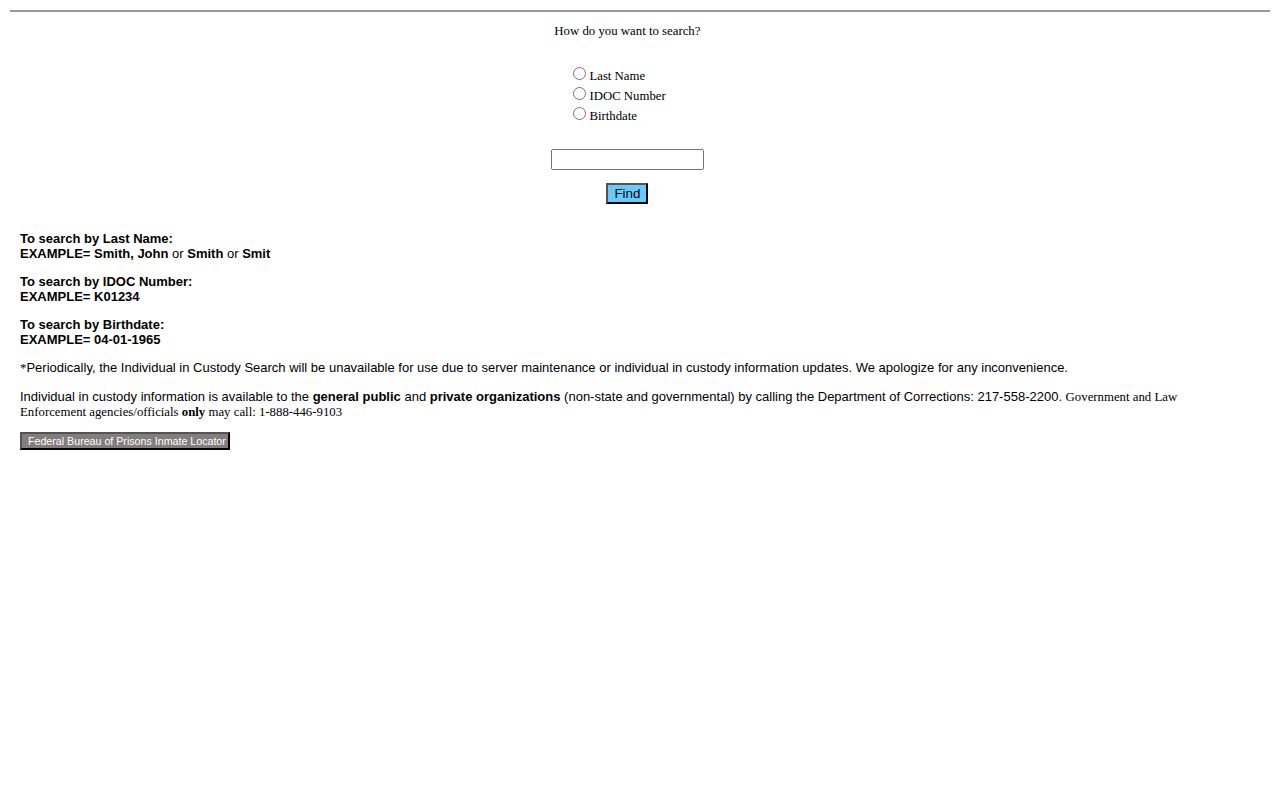
The IDOC result must be matched to the Clinton County court and jail records when the local custody leg matters. Fully discharged completed-sentence profiles may be removed from the live search. Use IDOC's archived Record Search route when that happens.
No Clinton Release Feed
The official Sheriff and jail page provides contact details but no roster, booking-photo gallery, or recent-release archive. It publishes no display window, update cycle, field list, or retention period. The Sheriff's official iOS app advertises tips and public-safety information, not an inmate or release function. Its Facebook page is a news channel, not a systematic release log.
For a list covering a precise interval, request any existing release or transfer report or database export and state exact start and end timestamps. Ask for exit type and destination so a transfer is not counted as community release. FOIA does not require the Sheriff to create a new report. If no aggregate exists, request the named person's booking and custody event.
Clinton Supervision After Release
Clinton County Probation, IDOC Parole Division, and the Illinois Prisoner Review Board have separate jobs. County Probation supervises court-ordered local probation and supervision. IDOC manages state field supervision. The Prisoner Review Board sets conditions and decides specified parole, MSR, and revocation matters. The complete Clinton County probation and parole process shows how to verify which agency applies.
The local office publishes programs and Community Resource Center connections, but it offers no public client lookup. The jail inspection also identifies the Community Resource Center as an additional mental-health service inside the jail. That is a documented custody-to-community link, not proof that any named person participated.
Clinton Release Alerts and Federal Records
Illinois VINE receives information from county jail booking systems, IDOC, the Department of Human Services, and circuit clerks. Search one person, note the reporting agency, and register for phone, text, email, or app alerts while the person is still in custody. A phone registration uses a four-digit PIN. A release alert is timely notice, not the documentary release record. A transfer alert means custody moved.
Federal systems require a different chain. The BOP Locator can show a past release date and RELEASED for a sentenced federal prisoner. That means no longer in BOP custody, but supervision or another jurisdiction may follow. ICE's locator is aimed at current detention, so no result cannot prove community release. USMS has no comparable public release archive. Clinton County can document when its boarding custody ended, while the federal docket and federal agency records explain what happened next.
Clinton Release or Current Custody
Each system has a limited scope. Use an affirmative event rather than a missing name.
| Source | Best use | Important limit |
|---|---|---|
| Clinton County Jail phone | Current local physical custody and the last local event | Phone information is not a certified historical record |
| Sheriff custody-event record | Local exit time, type, and destination | Does not describe an entire later custody chain |
| IDOC search | State custody, parole or MSR, and projected date | Completed profiles may leave the live database |
| VINE | Alerts from a contributing agency | Coverage and timing depend on the feed |
| BOP Locator | Federal prison custody and past BOP release | Not USMS, county, or ICE history |
| ICE ODLS | Current immigration detention assistance | No result is inconclusive |
Clinton County Custody Systems
Clinton County Jail is the local physical facility. It holds county detainees and also boards people for USMS and other counties. The statewide Illinois Department of Corrections system receives state commitments; no IDOC prison was found inside Clinton County. Federal and immigration custody may involve USMS, BOP, or ICE, depending on the documented transfer.
The jail was built in 1966, renovated in 1995, and has a rated capacity of 53. Those facts matter because the mixed boarding arrangement changes the meaning of an exit. Leaving the Carlyle building may be a return to USMS or another county, not a release into Carlyle.
Pair Clinton Court and Jail Records
Clinton County links a county-specific Judici case search, but the Circuit Clerk remains the official record keeper. The docket can preserve the release authority, dismissal, disposition, probation, sentence, or commitment. The Sheriff record supplies the physical exit time and destination. Neither source should stand alone when both are available.
A judge may order release while another hold delays the exit. A person may also leave the jail under a commitment order and remain in custody. Obtain verified or certified court documents from the Circuit Clerk when formal proof is needed.
Property Records After Clinton Release
The permanent, signed property receipt checked during the state jail inspection is a second way to document the discharge process. It is not a substitute for the custody-event field, but it can corroborate that property handling occurred during an exit. Ask for it by booking and date so the request stays narrow.
The jail inspection also reviews discharge linkage for detainees with mental-health needs. Health details remain protected. The safe conclusion is only that the inspection documents a process and a Community Resource Center connection, not that any particular released person received those services.
Clinton Release Orders Need Confirmation
Clinton County publishes no local bond schedule or public pretrial-services lookup. Illinois pretrial practice centers on judicial release and detention orders. Read that court order beside the Sheriff's actual exit event. This guards against two common errors: calling a transfer a community release and assuming an order was carried out despite another hold.
Does a court release order prove the person left? No. It proves legal authority in that case. The jail event shows when physical custody ended and whether another agency received the person.